Governments Should Fund Startup Travel Programs

Occasionally I meet a government official and he asks me, “What should the government do to help startups?”

I always say the same four things:

  1. Provide funds
  2. Get out of the way
  3. Make startup visas a reality (but this is a conversation for another day)
  4. And launch a startup travel program


Most governments already provide funds (although they should be continuously looking at how and where, and the efficacy of those funds, because I suspect a lot of money is wasted or given out inappropriately).

Some governments understand the need to get out of the way. By that I mean that governments should not dabble in startups. They should put the capital into capable and trustworthy hands, and let those people (who are hopefully experienced investors and/or startup operators) deploy the capital. This definitely happens in a few places, which is great. And there are also capable investor that are government employees too (just to provide the appropriate caveat here!)

Governments can also get out of the way by streamlining as many processes that involve startups as possible. Things like incorporation, filing taxes, employment paperwork, etc. should be as simple as possible for startups to do.

A lot of this is already working reasonably well. So neither of those suggestions are terribly actionable. But I think the fourth one is, and would be quite simple to realize.

The government should have a program that pays for entrepreneurs to visit San Francisco (Valley / Bay area) or New York to experience the best startup ecosystems around.

Here’s how I think about it:

  • Entrepreneurs that are based anywhere outside of the Bay area and New York need to get to the Bay area and New York (and perhaps elsewhere like Boston, or any major city that has a lot of startup activity) to learn and connect.
  • They need to go there because the acquirers, investors, partners and customers are all there.
  • The benefits of spending a few weeks in the Valley and San Francisco are incredible — you’ll build an instant and valuable network, you’ll see “how it’s done”, and you’ll bring some of that fire and spirit back. You’ll realize that the world is moving insanely fast and you need to do so as well to compete and win.
  • Traveling to the startup meccas of the world is an eye opening and unforgettable experience (I remember doing it in 2007 and it changed me).

It’s incredibly easy to plug into Silicon Valley. You need to know a couple key people and you need some money to get there and stay there (for longer than a week). You can anchor your visit around a couple of events (there are multiple events daily, so there’s plenty to do), and if you’re from Canada you can plug into existing networks like the C100 or other well known Canadian entrepreneurs. You can use Clarity to connect with Canadian entrepreneurs about going to the Valley to connect with other Canadian entrepreneurs (and non-Canadian ones too). Incidentally, Clarity is run by a Canadian (Dan Martell).

Of course, this idea is relevant for places other than Canada.

If you’re anywhere other than Silicon Valley or New York, a startup (or founder) travel program makes sense. When a government official in Omaha, Nebraska (where I was promoting Lean Analytics) asked me what the government could do, I pitched him the travel idea. Nebraska has a lot of great startup activity, but it needs to send its best entrepreneurs to San Francisco and/or New York to have their eyes opened in a big way.

When you go, you need to stay for a couple weeks at least. Three or four is even better. You don’t need to have a ton of meetings lined up, just go. And the government could pay.

It wouldn’t be expensive: ~$5-$10,000 each time. The government wouldn’t pay for everything, just cover the flight, a place to stay and maybe tickets to a couple of events (if they’re not free).

There would have to be a vetting process for the entrepreneurs (the government isn’t there to pay for your vacation to the Valley!) but this wouldn’t be hard to do. Put together a small group of startup leaders and get them to recommend entrepreneurs or vote on entrepreneurs that apply.

If we (in Canada) sent 20 entrepreneurs per year it would cost about $200,000 to do so, but the value would be incredible. Each one of them would come back more connected, with a lot more knowledge and a ton more enthusiasm and excitement. Plus they might find a customer or two, a partner, or an investor, all of which brings capital back into the country. Those twenty entrepreneurs become new connectors to key startup ecosystems that others can now leverage, which in turn builds stronger and longer lasting bridges between us and those ecosystems. Everyone wins.

I’ve seen some programs that help entrepreneurs get to the Valley, but I think more could be done. Hopefully someone makes it happen…


Lean Analytics is Now Available to Order (and you can win great prizes too!)

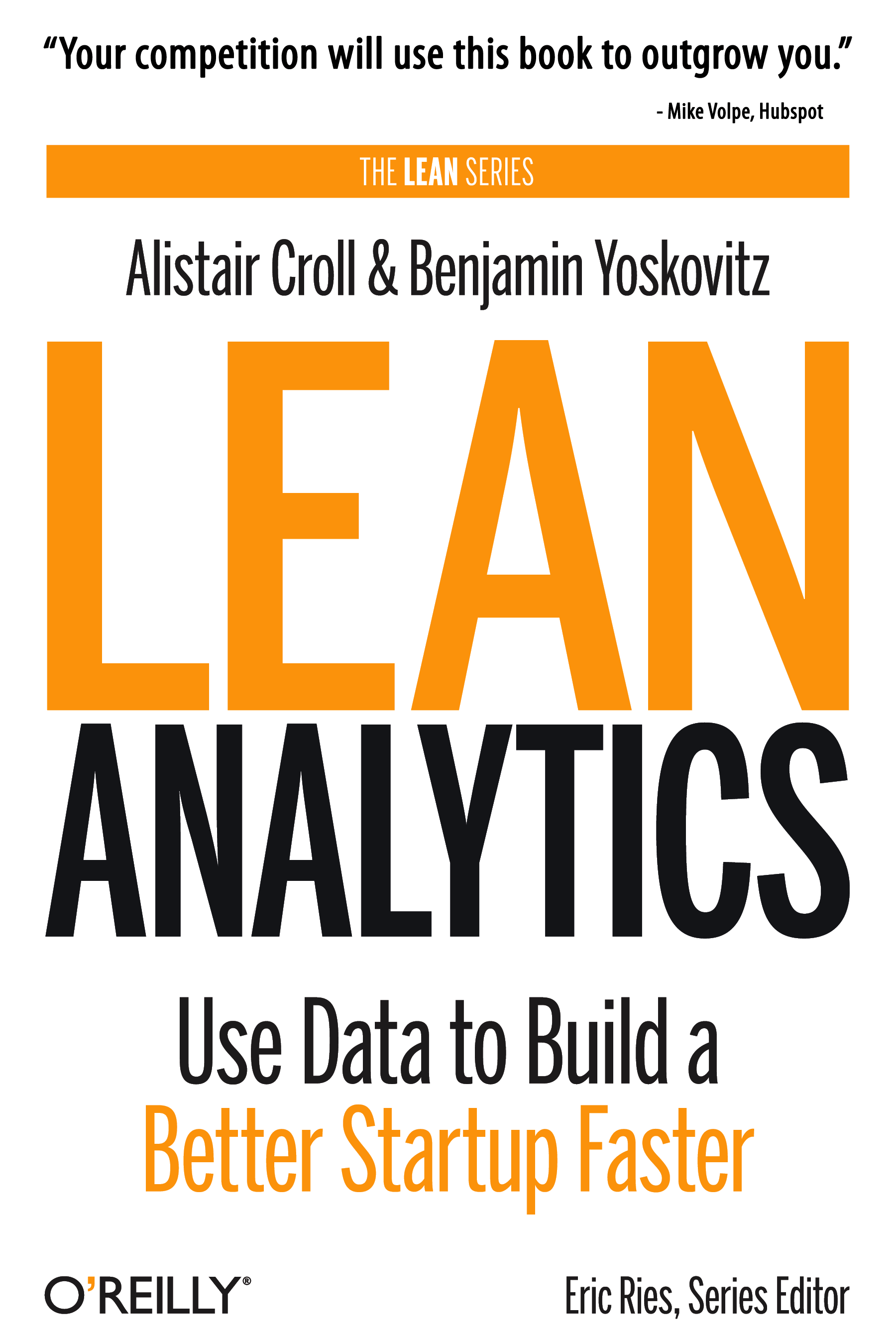
I know this blog has been quiet of late, but it’s with good reason. Lean Analytics is finally done and available for order. Find it in a bookstore near you soon. Or, if you’re too eager and can’t wait to get to a bookstore (yes, they still exist!), you can buy the book on Amazon or O’Reilly and get it immediately. You can get it in hardcover format or e-book.

The best place to go is here: http://leananalyticsbook.com/buy-lean-analytics-book/

If you buy the book or already have, then you can enter our awesome sweepstakes (which ends March 31st!) You could win a free trip to Startup Festival, and there are tons of other prizes.

Writing Lean Analytics with Alistair Croll has taken over a year. It’s been an interesting and amazing experience. I’ll write about it (probably a lot!) someday…but for now the focus is on promoting the book and getting people’s feedback. And we’re getting a lot of great feedback so far. Here’s my favorite to-date:

So what is Lean Analytics all about?

Well, I’d like to share two presentations with you that I’ve done recently that help shed some light on what we’re talking about. There’s some overlap between the two, but hopefully you find these useful.

Thank you to everyone that has bought Lean Analytics (and will). I can’t tell you how much it means to Alistair and I.


Enough Free Content

I produce a fair amount of content, and I give most of it away for free. I’m writing a book, and although the book costs money, it’s basically free (~$16 for the hard cover and ~$10 for the e-book); priced so low that it really shouldn’t be an issue for people. Plus it took over a year to write. And you don’t make any money from books (unless you sell an absolute shit ton of them).

People produce free content (published books included) to get people to buy other things from them or build a platform for themselves. That’s the crux of content marketing. Attract people with free content, monetize them in another way.

That’s what most magazines, newspapers and other content publishers do as well (online or in print). They produce content in the hopes of building a massive, loyal audience and then they monetize in other ways. Usually it’s advertising, which basically means they sell the hell out of their audience.

The audience is the product.

Advertising makes the Internet go-round, but I think enough is enough. Content publishers shouldn’t create content in order to sell the audience. They should create content to sell content.

The content should be the product.

If you want to make money from the content business, you should try charging for the content. It’s the fastest way to know if anyone gives a shit. If they don’t, they won’t pay. If they do, I’m betting they’ll pay. Not many of them, but the fact is that even in a Software-as-a-Service business or e-commerce business conversions are low–1-3% from free users or passersby to paying customers. Could you get 1-3% conversion on a content business, charging a subscription?

In order to make advertising work you need millions and millions and millions of page views. There’s no other way. Advertising rates are so low online, and I don’t think they’re going up. Let’s say you can get $5 CPM (which means $5 for every 1,000 page views) with an online ad unit. If you get 1,000,000 page views/month, you’re earning $5,000/month in revenue. (1,000,000 / 1,000 * $5) That’s not very exciting.

Instead, you could earn $5,000/month in revenue by finding 1,000 people willing to pay $5/user/month.

Which model would you prefer?

The Internet is a big place. If there aren’t 1,000 people interested in what you’re doing that are willing to spend $60/year, you really have to question what you’re doing.

We’re seeing content publishers experiment more frequently with the subscription model (and others, like paywalls). Marco Arment’s The Magazine is a good example. It costs $1.99/month and there are no ads. I’m not sure the issue approach is necessary (putting out issues at certain time intervals), but nevertheless, The Magazine is popular. And there are others. But many of the entrepreneurs I speak with that are in the content / media space still fall back on advertising as their core business model.

I think the answer to hyperlocal is also in subscriptions. People are interested in hyperlocal content (particularly in specific niches) but online advertising won’t work well enough. A small startup tackling a hyperlocal niche is not going to have the expertise or time to produce great content and hunt down advertisers (especially when advertisers are going to spend $20 for an ad). AllNovaScotia.com is a hyperlocal online business that provides business-centric content on a daily basis. It’s 100% behind a paywall. They have a very simple website and mobile application. That’s it. And it’s not cheap–about $30/month (with taxes). But it works. They’ve got thousands of subscribers. They provide a service that no one else does (the newspaper has business news, but not as much as what AllNovaScotia offers). AllNovaScotia isn’t a billion dollar company, but from what I hear they were profitable in their first year of operation and haven’t looked back.

Free content has its place. If you’re building your brand, trying to attract customers, demonstrating expertise or developing a platform from which you want to launch other things, then content marketing can work wonders. It’s not free to produce, but no one’s stopping you from publishing on the Web. And that’s awesome. But if you’re in the content / media business you need to look at alternative business models to advertising. As everything moves online and advertising rates stay flat (plus supply goes up), you have to look at subscriptions, paywalls and other revenue models that basically say, “If you like this content and want it, you have to pay for it. End of story.”


Ben Yoskovitz
I'm VP Product at GoInstant.

I'm also a Founding Partner at Year One Labs, an early stage accelerator in Montreal. Previously I founded Standout Jobs (and sold it).

My bio »

or

Follow me on Twitter

Get updates and special content
When I publish new content, get it directly in your inbox. Subscribers will get special stuff as well not available on the blog (but I promise it will be infrequent + high quality.)
or

Subscribe via RSS Feed

Get the Lean Analytics Book!
Advertisement
Startup Resources
Find Stuff
My Photos