WTF does that even mean?
It means: You’re not a young white guy.
And it’s total bullshit.
Heather Anne Carson, co-founder @ Repable recently posted this on Facebook:
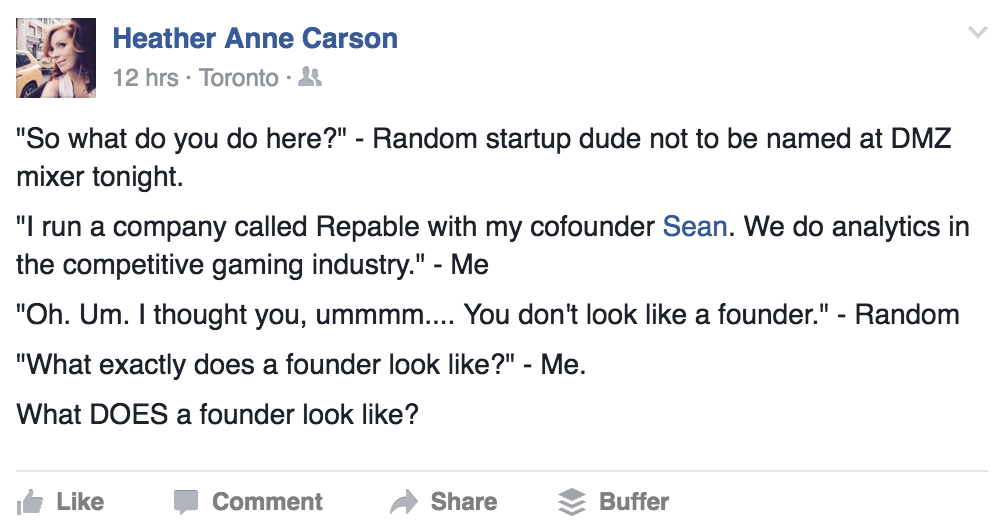
(She didn’t ask me to write this.)
Oy.
It’s not surprising that guys feel / think this way (but saying it out loud really demonstrates a whole new level of stupidity.)
Here’s the thing, I think of startup founders like comedians. Comedians come in all shapes and sizes. Their tool is their brain — their ability to make things funny, communicate that and engage an audience. That’s all the brain. You don’t even need real charisma (some comics are super awkward, and that’s what makes them funny). You can be fat, skinny, tall, short, young, old, white, black, blue (think: Blue Man Group), etc. There are lots of awesome female comics. There are lots of great comics of all shapes, sizes, genders, races, religions, and so forth. Comedy is ubiquitous across the world (most people like to laugh, those that do not, I weep for you, honestly.)
That’s not to say there isn’t discrimination in the comedy business (you know there is), but we have plenty of examples of comics that span the diversity on this planet. (I watched a Japanese woman comic the other day make fun of British people, it was hilarious!)
Founders are like comedians. Our main tool is our brain. Our drive. Our hustle. Our willingness to put ourselves out there (like comics) and do something new. It’s scary as shit, but we do it. Founders do come in all shapes and sizes, but unfortunately the world of startups is dominated by white men. It shouldn’t be (and I predict we’re going to see big time changes in this going forward.)
Here’s the thing: I’ve traveled all over the world and met a lot of founders. They’re all the same. They’re all trying to build something from scratch and make shit happen. A founder in San Francisco is the same as a founder in Canada. And they’re both the same as a founder in Amsterdam, London, Japan, Barcelona, Hungary, Brazil, and so on. In many of these countries, founders seem more timid, less “aggressive” than their American counterparts. That’s often the stereotype we push against in Canada for sure. And it’s partially true, but I don’t believe it’s some ingrained cultural instinct (at least not one we can’t defeat!)–I believe it’s because founders outside the United States don’t realize how good they are. They haven’t had the same level of support, examples and nudges as their counterparts in the US (particularly in Silicon Valley). As we build startup ecosystems and a startup culture in different places, founders across the world will realize they can compete; they’re just as smart, talented and driven. They just have to go do it. When that happens, we’re going to see diversity in entrepreneurship like never before, because we’ll have founders from all over building awesome companies and then inspiring generations after them. These founders will be of all colors, races, genders, religions, etc.
The criteria for being a founder:
- Do you have a brain in your head?
- Do you want to work your ass off and make real sacrifices to see your vision realized?
- Do you have a problem that you care deeply about?
- Are you ready to spend the next 5-10 years dedicated to solving that problem?
That’s it. Truth is, most founders don’t meet those criteria. They’re “founders” for other reasons (“I want to get rich” or “It’s a cool thing to do” or “It’ll look good on my resume.”) Too many founders don’t really have a meaningful enough problem worth solving. You know who does have problems worth solving? Everyone who is not a white guy from North America. (Of course, the world’s problems belong to white guys too, but hopefully you get my point.)
Shame on the “startup dude” who said, “You don’t look like a founder.” Pure nonsense. A founder looks like anyone. Literally anyone. Just like a comic. And the young white dudes in the startup world should desperately want and push for more diversity in our ecosystem. Without it we won’t really build global, sustainable startup cultures that make a true difference in the world.
Founders are driven to (hopefully!) make the world a better place, and there are tons of areas (geographically) and industries (globally) that need to be improved. If you think all of that change and improvement is going to come from Silicon Valley you’re fooling yourself.
Founders look like people. That’s it.
 Founding Partner at