I’m a big fan of Ash Maurya’s Lean Canvas. I was also very impressed with Steve Blank’s new initiative Lean Launch Lab, which combines a canvas business model tool and a blogging tool for startups to use and share information regularly with investors. If you haven’t seen it, check out his recent presentation: When the Boardroom is Bits. Both are very useful tools for designing a business model, and we’ve encouraged the startups at Year One Labs to use lean canvas and think about designing a business model vs. writing a business plan.
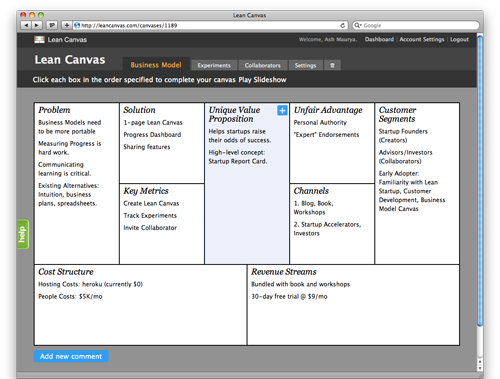
These tools are also very useful for enforcing rigorous thinking and processes in building a startup. Lean Canvas for example, gets you to write down your hypotheses, describe how you’ll test them and measure results week after week. It’s too easy for founders to get distracted, wander off and lose focus. It happens to all of us, but lean canvas and similar concepts help maintain that focus and instigate a lean startup / customer development-centric approach.
But in our experience at Year One Labs, these business model generation tools don’t go far enough. More specifically, they don’t go deep enough. They’re still high level in terms of their definition for things like Problem and Solution. But there are a lot of things you’ll want to do with your startup, and a lot of problems you’ll encounter that don’t fit in appropriately into the canvas.
For example, let’s say you’ve built the first version of your MVP to test the Problem and Solution in your lean canvas. You start attracting people to the MVP but can’t get enough into it. You don’t have enough test subjects to really make judgment calls on how things are going. So your key, immediate problem is a lack of test subjects. Faced with these kinds of things, founders will go in a number of different directions. Some will overanalyze their existing metrics to look for the necessary trends and proof to validate their hypotheses. Others will build more features into their MVP, convinced that it’s just not good enough to show people and that’s why they can’t get test subjects.
These sorts of problems are hard to track in business model canvases. So we designed our own Problem-Solution Canvas at Year One Labs to keep people hyper-focused on daily and weekly goals. It’s currently in PowerPoint format – you can download it here. This is a work in progress. We’re experimenting with it internally to see how it goes. We use it at our weekly meetings. Here’s what it looks like:
Problem – Solution Canvas: 1st Page
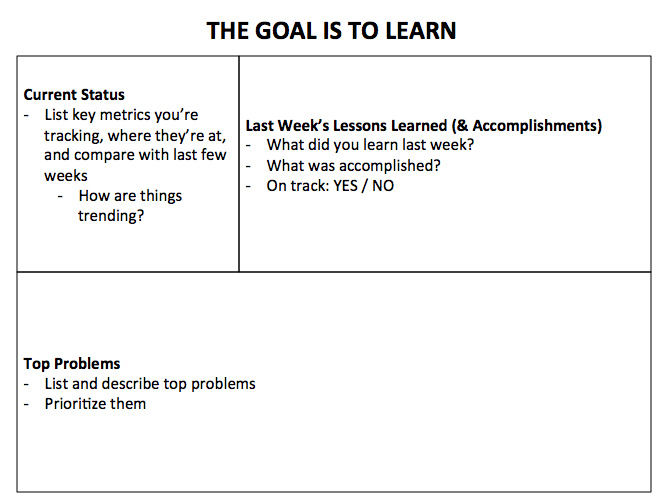
- Current Status: In many cases this is the least interesting piece (that’s why it’s the smallest). You list the 2-4 key metrics you’re tracking and how they’re going. Metrics don’t necessarily mean application metrics, it could mean things like the number of interviews done and how they went.
- Lessons Learned (& Accomplishments): Most important thing here is the lessons learned. Each week we have an expectation / hypothesis around what’s going to be learned (based on what’s going to be done), so we can see how things are going. Accomplishments are less interesting, but often where entrepreneurs like to share the most.
- Top Problems: There shouldn’t be more than 3 or so problems listed here. And they should be ranked. This is where our canvas goes deeper than the lean canvas or Steve Blank’s solution. We’re getting into the nitty gritty on issues so we can really keep entrepreneurs focused. As we solve (or don’t solve) problems here, it bubbles back up logically to the bigger, broader canvas. If you can’t get 50 people to try out your MVP, you use that to re-evaluate the original Problem – Solution hypotheses that you made. Or if you find that a specific target market isn’t responding as expected, you might adjust the Customer Segments in your lean canvas. Entrepreneurs struggle here because they often focus on problems that aren’t necessarily critical to validating (or invalidating) the original hypotheses. It’s easy to get distracted with issues like UI or “missing” features. But we’ve found that the canvas helps focus people and we use it to anchor our discussions. A quick test to see if you’re focusing on the right problems is to ask yourself, “If I solve this problem or do this specific thing, does it help me learn more about the core value of my idea? Do I get closer to having the necessary proof to decide if my idea is really worth pursuing or not?” If the answer to these questions is “no” you’re focused on the wrong things.
Problem – Solution Canvas: 2nd Page
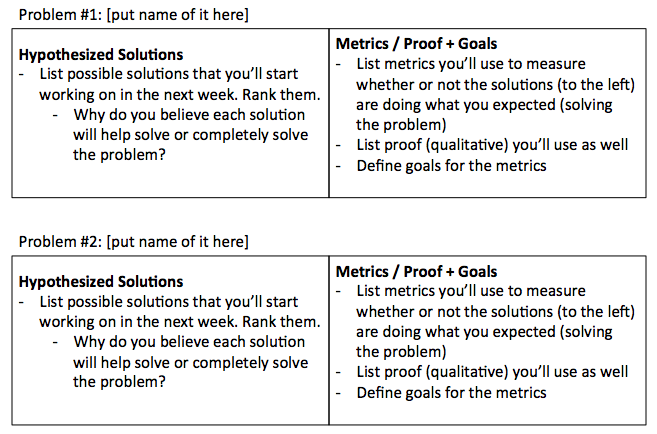
With the top problems defined, take those and put them into the 2nd page of the canvas. This page only shows space for 2 problems, but there could be more.
- Hypothesized Solutions: We use this term “hypothesized solution” very specifically because we don’t know if the solution is going to work. And we’re trying to get to the logic and thinking behind the hypothesized solutions, not just assume, “If we build X, it’ll work.” Asking “WHY?” is a very powerful tool. It’s also important to remember that hypothesized solutions don’t always have to deal with code. In fact they more often or not deal with the core issues around customer development – you need to speak with more people, you need to talk to your users, you need to test different value propositions, etc.
- Metrics / Proof + Goals: Here we ask entrepreneurs to put in the qualitative and quantitative metrics they’ll use to test their hypothesized solutions. We also ask for goals. This is one of the hardest things for people to do because they don’t have a lot of insight into what’s going to happen. Let’s say a key problem is that you still don’t have enough users testing your early MVP to validate its value. Well how many more do you need? How many more can you get in a week? How many more will your hypothesized solution deliver? We push hard on setting goals because it forces people to think about tangible results not just, “We made some progress.” It’s not really about the numbers because we’re not evaluating hardcore metrics or focusing on optimization, it’s about getting entrepreneurs to make judgement calls and take a stand.
Focusing on the right things at the right time is critical. And we believe that the Lean Startup methodology is a big driver of that. Our Problem-Solution Canvas is designed to help as a tool for really evaluating progress, and looking at things honestly. Without it, we’ve found that weekly meetings tend to go in too many directions. It’s fun to brainstorm future feature ideas and possibilities – but in the here and now entrepreneurs have to accomplish an absolute ton. Lean Startup and Customer Development aren’t easy. On paper it looks reasonably easy, but executing is another story. It doesn’t come natural to many people, and you spend more time proving yourself wrong than right. That’s hard to take. We’ve found the Problem-Solution Canvas keeps everyone on track with both the big vision and focusing on the big issues (around problem, solution, market, value proposition, etc.) while staying honed in on details and day-to-day issues.
Since this is a work in progress, I’d love to get your feedback on its value, how you could see it changing, etc. And if you do anything like this yourself, or take up the canvas for your own efforts, please let me know. Here’s the download link again: Problem – Solution Canvas.
 Founding Partner at