Lately, I’ve been doing a lot of pitching to investors, including angel investors and venture capitalists. It’s a fact of life when you run a venture-backed startup. It’s one of those things that no one ever tells you about raising money — once you start, you never stop.
It will take on average 4-6 months to raise money, so when you raise an early seed round (say in the $250k-$500k range) it won’t last long. That means the minute you cash that check, you’re out there again, raising more.
I’ve written about pitching investors before. And I’ve also posted some common questions investors will ask during the investment process. The points I made in both posts remain true, but here are some additional insights I’ve learned over the last few months of pitching, pitching and more pitching:
- Tell Your Story Quick. When pitching investors you have a captive audience. But they won’t stay captive for long unless you can hook them. And to-date I’ve seen two things that keep investors’ early attention on you versus their Blackberrys:
- An entertaining story on the problem you’re solving
- An entertaining story on the founders and how the company came together
Both of these points are about putting some context and relevancy on the upcoming pitch and discussion. If you make the problem feel real and explain it in an entertaining way it’s going to resonate much more strongly with investors. The same holds true with the history of the company. They want to hear about each founder’s strengths, background and how you were drawn together to create this new business. That has to be done in a relaxed, entertaining way.
Here are 3 slides I used recently in the beginning of a presentation from CIX where Standout Jobs was named one of Canada’s Hottest 20 Startups.


You don’t get all the context without hearing me go through the presentation, but the key is that I was illustrating very simply – at a high level – the problem we’re trying to address.
- Change the Pace Throughout. Whether a presentation is 5 minutes or 50 minutes (or anywhere in between), you need to change the pace throughout. Speed up when telling high level stories, which also allows you to go through more rapid slide changes to keep people’s attention. Slow down when you’re getting into the meat & potatoes, so people can digest the details. When I first started pitching I know that I did so with a very monotone pace. Everything was well timed, but there wasn’t enough variation.
- Sexy Slides Work. I know you’re not selling vaporware or snake oil, so I have no problem promoting slick presentations. You’re not trying to pull the wool over people’s eyes with “style over substance” but you need to make things look good. I’ve seen too many presentations where the slides were simply painful to look at; and you can watch people in the room tuning out almost instantly. No matter what you’re pitching – from cool consumer apps to ultra-complex B2B technology – find a way to make your slides sing.
Here’s an example of a slide I’ve used which I think works well. It’s nice looking, bold and has a few key points on it:
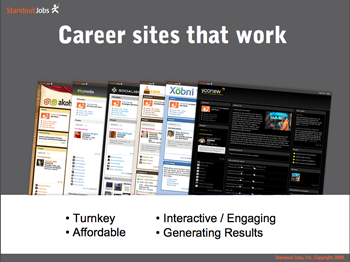
Side note: Don’t be afraid to play around with font sizes, colors and typefaces for things like slide titles. Everything shouldn’t be absolutely uniform.
- Don’t Over Emphasize the Product. Unless your product is dead simple, you won’t be able to go through all of its great features and benefits in a short investor presentation. Don’t even try. You want to highlight the key elements of the product, but ultimately investors are buying into the team (i.e. the founders), the passion, and the belief that you can execute on what you claim you can execute on. They love to see barriers to entry, intellectual property, etc. but they don’t want to become experts in your product after one pitch.
- End Strong. Most presentations leave the detailed financials to the end. Of course, investors want to know about your financial situation and projections, but ending just on that is pretty dry. Plus, they’ll be assuming that most of your projections are wrong anyway, especially if you’re at a very early stage. So find a way to end as strong as you can. In the last pitch I did, I listed out 4 key points I wanted the investors to remember. It was my, “If you leave here remembering only a couple things…here’s what you need to know…”
And recently, I got some interesting advice, which was to make sure the audience is drawn back to you at the end of the presentation and not focusing on the slides. You want them looking at you, making eye contact, and really getting a feel for your confidence and passion. I was told that the last slide should be as minimalistic as possible; even down to just showing your company’s logo. No matter what you do, end strong by highlighting the few critical things you want investors walking away with in their heads.
Pitching investors is hard.
I’ve met very few people who are really comfortable with it, and fewer still that enjoy it. I did not enjoy the process early on. But the more I pitch (and present in front of larger audiences), and the more I hone my Powerpoint skills and realize that I’m really just telling a story, the more comfortable and effective I become. And you do get better with practice. Good luck!
 Founding Partner at